
Sketching the Solution
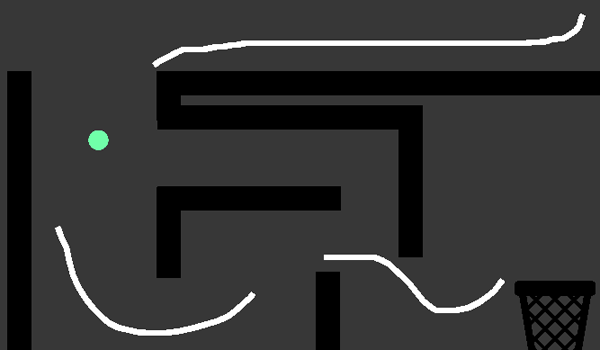
Every stage in Line Draw Roll Quest begins with two fixed points: a ball and the container it must reach. Your only tool is a drawn line. By dragging a finger or moving the cursor, you create a continuous path that the ball will roll along. The line becomes a physical surface, so its shape determines whether the ball arrives safely or falls short. Because the mechanic is simple, new players can start immediately, but later puzzles require precise curves and deliberate angles to succeed.
Hazards That Break the Path
Straightforward routes rarely survive contact with the level design. Moving spheres patrol certain sections and can knock the ball off course if your line crosses their trajectory. Solid barriers block direct paths, forcing you to route around them. Open gaps in the floor break the drawn line entirely, so you must bridge them with careful strokes. Recognizing how these elements interact early in a stage helps you plan a trajectory that accounts for timing and spacing rather than reacting mid-roll.
Gradual Skill Building
Early puzzles keep distances short and obstacles sparse, giving you room to learn how line thickness and slope affect the ball's movement. As you progress, stages combine multiple hazards, longer routes, and tighter spaces. The difficulty curve is steady: each new element appears in isolation before being mixed with others. That structure lets you build a mental toolkit of solutions without feeling overwhelmed, and every completed puzzle delivers a clear sense of accomplishment.
Clarity in Visuals and Controls
The graphics use bright, distinct colors to separate the ball, obstacles, and background, so you can read a layout at a glance. Controls respond smoothly to both touch and mouse input, which keeps line drawing precise across devices. A minimal interface removes distractions, and gentle sound effects provide feedback without pulling focus from the puzzle itself.
Comments
0 comments