
Running and Arithmetic Combined
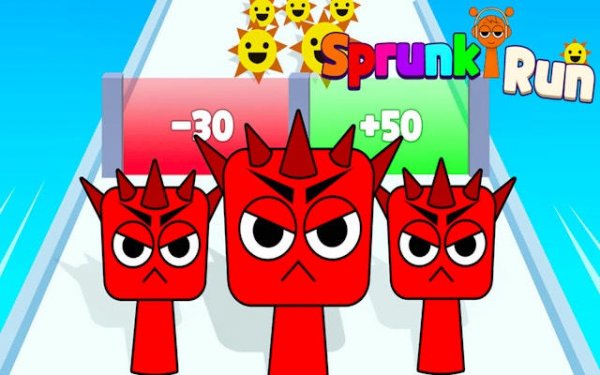
Sprunki Math Runner Adventure places a team of Sprunkis in a continuously scrolling 2D path. The immediate goal is distance: keep the group moving as far as possible. What separates this from a standard endless runner is that progress depends on two skills at once. You must dodge rolling obstacles and time jumps over barriers, but you also need to solve simple math problems that appear during the run. Choosing the correct numbered door adds Sprunkis to your squad, while a wrong pick costs you momentum. The result is a run that tests reflexes and mental arithmetic in the same moment.
Controls and On-Screen Decisions
Everything is handled with taps. A tap makes the team jump, a swipe or second tap slides under low barriers, and a tap on a numbered door selects it. Because the path and puzzles are generated differently each time, you cannot memorize a fixed route. Instead, you learn to read obstacle patterns and recognize when a math prompt is about to appear. The controls are intentionally simple, but the decisions are not: a late jump or a rushed door choice can end a promising run. That balance keeps each attempt distinct.
Team Growth and Puzzle Rewards
Your Sprunki squad is more than a visual counter. Correct door choices increase the team size, which gives a clearer sense of progress within a single run. Solving math puzzles quickly can also unlock abilities that clear the path or provide a boost. These rewards are tied directly to the running action, so you never leave the movement to answer a question in isolation. The strategic layer comes from deciding when to prioritize speed and when to slow down mentally for a puzzle. Players who practice both timing and quick calculation tend to reach longer distances.
Visual Style and Audience
The game uses bright, cheerful visuals and upbeat music. That presentation, along with tap-based controls and basic arithmetic, makes it approachable for younger players and casual adults. The difficulty rises as speed and obstacle complexity increase, so the challenge scales without changing the core rules. Because the path and puzzles are generated to prevent repetition, there is a reason to replay beyond a single high score. It suits short sessions as well as focused practice, though the math is simple by design rather than a deep educational curriculum.
Comments
0 comments