
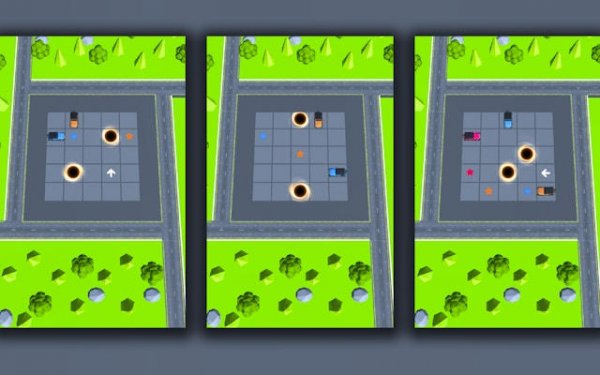
Core Puzzle Mechanics
Each level presents a grid filled with vehicles, each confined to a single lane. The objective is to slide every car forward or backward along its lane until it reaches a marked parking space. Vehicles cannot move diagonally or pass through one another, so every move must be considered. Some grids include teleportation tiles that instantly move a car to a linked location, adding a layer of strategic planning. This push-and-pull loop creates a sequence of small victories as you clear the board.
Progression and Difficulty
Puzzles start with small grids and few cars, letting newcomers grasp the basic rules quickly. As you advance, the grid expands and more vehicles appear, requiring longer move sequences. Later stages introduce teleporters that connect distant parts of the board, forcing you to think about timing and order. The difficulty ramps up gradually, so each new challenge feels earned rather than frustrating. Players can replay earlier levels to improve their move count or simply enjoy the satisfaction of a solved puzzle.
Visual Style and Atmosphere
The game adopts a clean, minimal visual approach with bright colors and simple shapes. Each vehicle is easily distinguishable, and parking spots are clearly marked. The interface avoids clutter, letting you focus entirely on the logical problem. Subtle animations for car movements and teleportation effects provide feedback without being distracting. This design choice makes the game suitable for quick sessions during a commute or longer play periods at home.
Family-Friendly Accessibility
Controls are straightforward: tap or click a car to select it, then swipe or use arrow keys to slide it along its lane. No reading is required, so young children and non-native speakers can play immediately. The lack of timers or pressure points means players can think at their own pace. Parents can enjoy the puzzles alongside their kids, discussing strategies and celebrating solutions together. This inclusive approach makes the game a welcome addition to any family game library.
Strategic Thinking and Planning
Solving a puzzle often requires moving a car out of the way temporarily, only to bring it back later when the path is clear. Teleporters can shortcut these detours but must be used wisely, as they may send a car to an unexpected location. The best approach is to visualize the entire sequence before making the first move. Over time, players develop pattern recognition skills that help them spot common configurations and solutions more quickly. Each puzzle is a self-contained logic problem that rewards patience and foresight.
Comments
0 comments