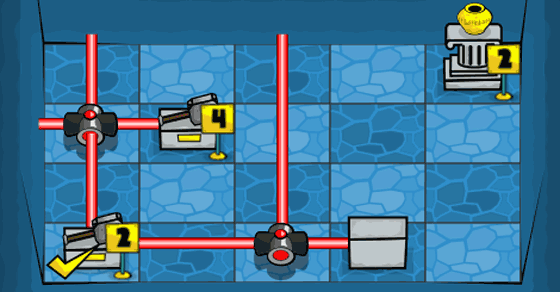
Museum Security Logic Puzzle

Museum Security Logic Puzzle

Developer: Artisan Pixel Core
Published: 1761840000
Updated: 2026-09-30
Logic Puzzle Security

Reviews

Museum Security Logic Puzzle focuses on a single clear mechanic: place and rotate emitters until every open floor tile is covered. The absence of timers makes it approachable for players who dislike pressure, and the visual feedback showing covered areas helps you learn from each attempt. Progressive difficulty keeps later layouts from feeling repetitive. The main limitation is that the input does not describe audio, story, or additional modes, so the experience appears to be purely puzzle-driven. It is best suited to fans of spatial reasoning and family-friendly brain teasers.

About this game

Core Objective and Setting

Museum Security Logic Puzzle puts you in the role of a security specialist responding to a break-in. The museum's artifacts need protection, and your job is to design a beam-based security system that leaves no open floor space uncovered. Each level presents a different floor layout, so the solution from one puzzle rarely applies to the next. The premise is straightforward: cover everything, leave nothing exposed.

Placing and Rotating Emitters

You interact by clicking or tapping on the museum floor to place a beam emitter. Once placed, you can rotate the emitter to change the direction its beam travels. The goal is to cover the entire floor area with beams, and the game shows covered areas in a different color so you can see your progress at a glance. If a placement doesn't work, you can remove or replace emitters, or restart the level entirely.

Pacing and Accessibility

There are no timers or pressure mechanics. You can think through each puzzle at your own pace, which makes the game suitable for players who prefer reflection over reaction. Controls work on both desktop and mobile devices. The graphics are clean and simple, keeping the focus on the puzzle grid rather than distracting visuals.

Difficulty Progression

As you advance, new challenges appear. The game introduces progressively harder layouts, so early puzzles teach the basic placement and rotation rules while later ones demand more careful planning. Because there are no time limits, difficulty comes from the complexity of the floor plan and the constraints of beam coverage, not from speed.

Who This Is For

This is a family-friendly logic game with no violent content. It appeals to players who enjoy spatial reasoning, pattern recognition, and quiet problem-solving. If you like puzzles where you can pause, rethink, and try a different approach without penalty, this fits that style.

Editorial Notes

Compatibility

This H5 game runs smoothly on:
• Desktop computers (Windows / Mac) • Mobile phones (iPhone / Android)
• Tablets (iPad / Android)
🌐 Best experienced with Chrome, Safari, or Edge

Faq

Do I need to place a specific number of emitters to solve each level?
The game does not impose a fixed emitter count. You can place as many as you need, remove them, and try again. The only requirement is that every open floor space ends up covered by a beam. Experimenting with different numbers and positions is part of the puzzle.
Can I undo a single emitter placement without restarting the whole level?
Yes. You can remove and replace individual emitters. If you want to start over completely, there is also a restart option. This means a wrong placement costs you nothing but the time to adjust it, which supports a trial-and-error approach.
Is there a time limit or score penalty for taking too long?
No. Museum Security Logic Puzzle has no timers or pressure mechanics. You can leave a puzzle, come back, and take as long as you like. The game is designed for relaxed, thoughtful play rather than speed or reflex challenges.
Does the game work the same on phones and tablets as on desktop?
The controls are responsive and work on both desktop and mobile devices. You tap or click to place emitters and rotate them. The clean visual style is intended to remain readable on smaller screens, though the puzzle grid may feel more comfortable on a larger display.
Are the puzzles randomly generated or hand-designed?
The input describes each level as a unique layout with progressive difficulty, but it does not specify whether layouts are hand-crafted or procedurally generated. What is clear is that each level requires its own logical solution and that new challenges appear as you advance.
Is this game appropriate for children?
Yes. It is described as family-friendly with no violent content. The gameplay promotes problem-solving and critical thinking. There are no mature themes, and the simple graphics keep the experience neutral. Parents looking for a logic puzzle for younger players will find it suitable.

Comments

0 comments
U
User
★ ★ ★ ★ ★
Loading comments...